
Summer Watering and Mowing to Prevent Brown Lawns
South Jersey summers are hard on lawns. Once July heat locks in across Atlantic County — humid nights, scorching afternoons, and sandy soil that drains fast — the margin between a green lawn and a brown one comes down to two things: how you water and how you mow. Get those right and your turf stays resilient. Get them wrong and you're fighting fungus, shallow roots, and stress damage through September.
Most lawn problems in this area aren't caused by drought or disease on their own. They're caused by bad habits that compound under heat. The good news is that fixing them costs nothing but a schedule change and a blade sharpening. Here's what to do.
How Much Water Does a South Jersey Lawn Actually Need?
One inch per week is the standard target, and it holds for most cool-season and warm-season grasses grown in Atlantic County. The goal isn't to keep the top inch of soil damp — it's to push water eight to ten inches down so roots chase it deep. Deep roots are what keep a lawn green when air temps hit the 90s.
Run your irrigation or sprinklers long enough to hit that inch, then stop and don't water again until the soil starts to dry out. You can do a simple catch test: set a few empty tuna cans around the lawn, run the sprinklers, and time how long it takes to collect an inch. That number is your runtime.
- Frequency. Two deep sessions per week is usually better than daily light passes in this heat.
- Timing. Always water early morning — between 5 and 9 a.m. — so grass dries off before afternoon.
- Avoid evening. Watering at night leaves blades wet for hours, which is exactly the environment fungal diseases need to take hold.
Does Sandy Coastal Soil Change the Rules?
Yes. If your property sits in Galloway, Brigantine, or anywhere close to the barrier island side of Atlantic County, your soil drains faster than inland loam. Sandy soil doesn't hold moisture as long, which means even if you're hitting one inch per week, you may need to split that into three sessions instead of two to keep roots from drying out between waterings.
The fix isn't to water more total — it's to water more often while still watering deeply each time. Running a sprinkler for five minutes every day is still the wrong approach. Even in sandy coastal soil, shallow watering trains roots upward where they're more vulnerable to heat stress. Go deep, go less often than you think you need to, and let the surface dry between sessions.
What Mowing Height Should You Use in Summer?
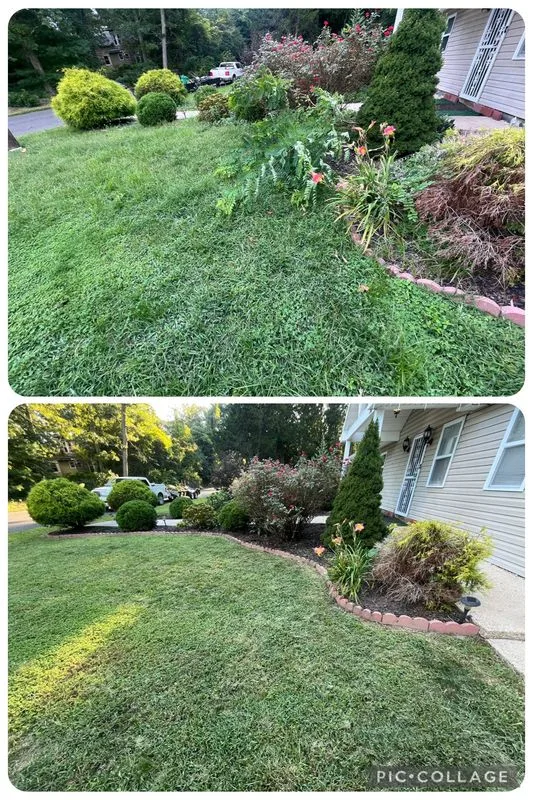
Raise your deck. During June, July, and August, set your mower to cut at 3.5 to 4 inches. Taller grass shades the soil underneath, which slows moisture evaporation and keeps soil temps lower. It also physically crowds out weeds — crabgrass and spurge can't establish as easily under a thick, tall canopy.
This is one of the most impactful things you can do for a summer lawn and it costs nothing. Scalped lawns bake in the Atlantic County sun. You can always drop the height back in September when temps moderate.
- The one-third rule. Never cut more than one-third of the blade height in a single mow. If your grass is at 5 inches, don't take it below 3.5 in one pass.
- Blade sharpness. A dull blade tears grass instead of cutting it, leaving ragged ends that brown and invite disease. Sharpen your blade at least once mid-season.
- Timing the mow. Avoid mowing during peak afternoon heat and never mow wet grass. Both stress the lawn and leave an uneven cut.
For more on keeping your lawn in shape through the hottest months, see our summer lawn maintenance tips for Atlantic County.
Should You Bag Clippings or Leave Them?
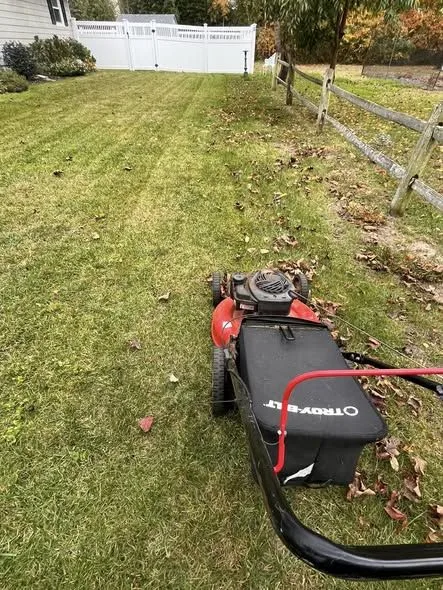
Leave them. Grasscycling — letting clippings fall back onto the lawn — returns nitrogen to the soil as they break down. In peak summer heat, that's essentially a free, light fertilizer application. Clippings from a sharp blade cut into small pieces that settle into the turf quickly and don't create thatch when the lawn is mowed regularly.
The only time to bag is when your grass is diseased or you've let it get so long that you're leaving heavy clumps on the surface. Otherwise, grasscycle every cut. It's better for the soil and saves you the hassle of bag disposal.
Is a Tan Lawn Dead, or Just Dormant?
Dormant. Most grasses native to or adapted for New Jersey go tan during drought stress — it's a survival mechanism, not death. The crown of the plant (at soil level) stays alive even when the blades lose color. Once rainfall or irrigation resumes, the lawn greens back up within a week or two.
If you're going to let dormancy happen, commit to it. Inconsistent watering during dormancy — a little here, a little there — stresses the plant more than just letting it go brown and leaving it alone. Either water consistently enough to prevent dormancy, or step back and let the lawn rest until conditions improve.
If you handled spring lawn care correctly — aeration, overseeding, appropriate fertilization — your lawn goes into summer with deeper roots and better heat tolerance overall.
How Do You Tell Heat Stress From a Lawn Disease?
Heat stress looks uniform. The whole lawn or large sections fade evenly, usually in the hottest, most exposed areas first. It follows sun exposure and drainage patterns. Recovery is quick once watering resumes.
Disease looks patchy. You'll see irregular circles, rings, or blotchy areas. Dollar spot shows as small bleached patches. Brown patch (common in our humid SJ summers) shows up as tan circles with a darker border, often in areas that stayed wet overnight. Pythium blight can move fast in hot, humid conditions and usually appears after a stretch of warm, wet nights.
- Heat stress. Uniform fading, entire lawn or large sections, recovers with water.
- Fungal disease. Distinct patches, rings, or circles, often with discolored borders, doesn't recover with watering alone.
- Action. If you're seeing circles or rings, stop evening watering immediately and call a professional before applying fungicide — misidentification wastes money and time.
Our lawn care services cover diagnosis and treatment if you're not sure what you're dealing with. A lot of homeowners in Northfield and Somers Point come to us mid-summer thinking they have a disease when it's actually compacted, shallow-rooted turf suffering from drought stress. Getting the right answer first matters.
Need Help With Your Property?
Sean Patrick Services handles lawn care, landscaping, drainage, cleanups, and outdoor improvements across Atlantic County, NJ. Call 609-783-5287 or get a free estimate online.