
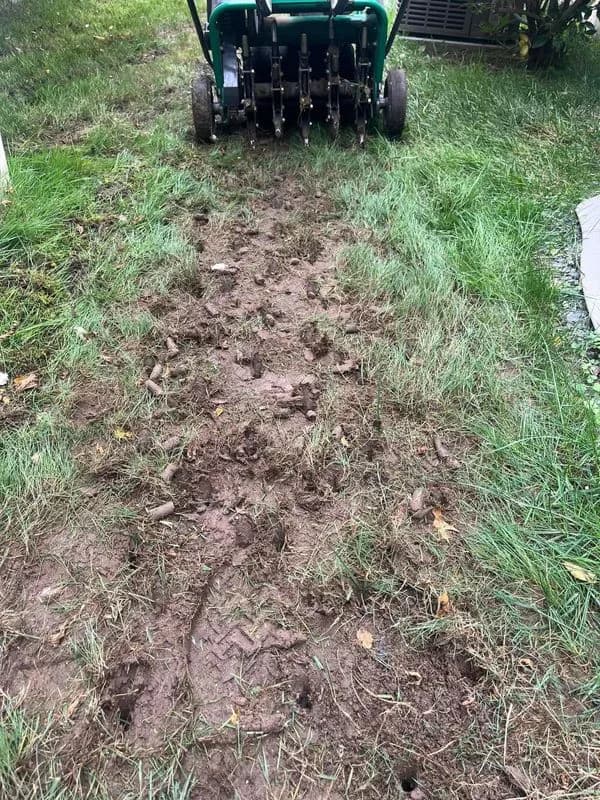
By the last week of July, most Atlantic County lawns look rough. Tan patches, thin spots, a crunchy sound when you walk across the yard. Homeowners in Egg Harbor Township and Northfield call us this time of year convinced their lawn is dead and needs to be torn out and replaced. Usually it isn't. Usually it's asleep.
The trick in August is telling the difference between grass that's protecting itself and grass that's actually gone. One of those fixes itself for free when the weather breaks. The other needs real repair work in the fall. Here's how to sort your lawn into those two piles before you spend a dollar on it.
How Do You Tell Dormant Grass From Dead Grass?
Do the tug test. Grab a handful of the tan grass and pull straight up, firmly. Dormant grass holds. The roots are still anchored, the crown is alive, and you'll feel resistance — you might pull a few loose blades but the plant stays put. Dead grass comes up in your hand with no fight at all.
If a whole section peels back like a strip of carpet and you see white, C-shaped larvae in the soil underneath, that's grub damage, not heat. Grubs eat the roots, so there's nothing holding the turf down. That's a different problem with a different fix, and it does need attention rather than patience.
Walk the whole yard and do this in five or six spots. Most lawns come back mixed — the shaded areas and anything near a downspout still firm, the strip along a south-facing driveway or the high spot the sprinkler never quite reaches pulling up loose. Now you know your actual repair footprint instead of guessing.
Why Does My Lawn Turn Tan Every August?
Nearly every lawn in South Jersey is cool-season turf — tall fescue, fine fescue, some ryegrass and bluegrass mixed in. Those grasses evolved for spring and fall. Their peak growing temperature is well below what we get in July and August here.
When soil temperature climbs and rain stops, cool-season grass makes a decision: stop pushing top growth, pull resources down into the crown, and wait. The blades go tan because the plant stopped feeding them. It's a survival mechanism, not a death sentence. Healthy fescue can hold dormancy for several weeks and green back up within two weeks of consistent cooler nights and real rainfall — which in Atlantic County usually means early to mid September.
The one thing that helps during dormancy is a deep soak every couple of weeks, enough to keep the crowns alive without trying to force the lawn awake. We break down the timing and depth in our guide to summer watering and mowing to prevent brown lawns.
What Does Brown Patch Look Like on a Shore Lawn?
Not every brown area is drought. Living this close to the water means humid nights that barely drop below 70, and that's exactly the condition brown patch fungus needs. We see it constantly in Somers Point, Absecon, and the neighborhoods around the bay where the air stays heavy after dark.
Brown patch shows up differently than heat stress. Look for roughly circular patches, a foot to several feet across, with an irregular edge. Early in the morning before the dew burns off you may see a darker gray-purple ring around the outside of the patch. Individual blades will have tan lesions with a dark border, rather than the uniform fade you get from drought. Heat stress follows the sun and the slope; brown patch shows up in circles that don't line up with either.
The biggest thing you control is when you water. Evening watering leaves the leaf blades wet for eight or ten hours straight through the warmest, most humid part of the night. That is the fungus's ideal environment and you're building it on purpose. Water between 4 and 8 in the morning instead — the blades dry within a couple hours of sunrise and the disease loses its window. Bag your clippings while an outbreak is active, and don't push nitrogen, which feeds the lush tender growth the fungus prefers.
What Should You Not Do to a Lawn in August?
Most of the damage we get called to fix in September came from someone trying to help in August. Four things to leave alone:
- Don't fertilize heavily. Nitrogen tells a stressed plant to push new blade growth it doesn't have the water or root capacity to support. You're spending money to make the lawn weaker and feeding fungus at the same time.
- Don't seed yet. New seedlings have almost no root system and can't survive August soil temperatures. Seed thrown down now mostly germinates, cooks, and dies, and you'll be buying it a second time in six weeks.
- Don't cut short. Raise the mower to 3.5 or 4 inches. Taller blades shade the soil, keep root zone temperature down, and hold moisture. Scalping a dry lawn in Galloway in August will kill grass that would have survived.
- Don't mow dormant turf at all if you can avoid it. If it isn't growing, there's nothing to cut, and the mower's weight and tires stress crowns on hard dry soil. Wait for rain.
Also keep foot traffic and parked vehicles off tan areas. Dormant crowns are alive but fragile, and compaction on dry soil is one of the few things that turns recoverable dormancy into actual dead turf.
When Is the Right Time to Repair What's Actually Dead?
September. That's the whole answer, and it's why triage in late July matters — you're building a repair list now for work that happens six weeks from now.
Fall is the repair season in South Jersey for a straightforward reason. Soil is still warm enough for fast germination, air temperatures are dropping, night humidity eases off, and rainfall becomes more reliable. New grass gets a long cool runway to establish roots before winter, then a full spring to thicken up. Seed planted in September has months to work. Seed planted in August has days.
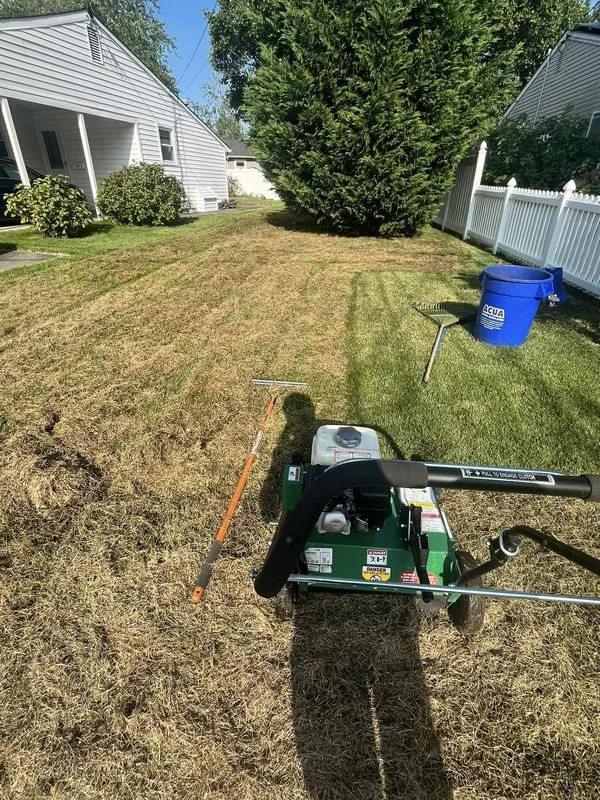
The standard fix for heat-damaged turf is core aeration followed immediately by overseeding. Aeration pulls plugs out of soil that's been baked and compacted all summer, opening channels for water, air, and roots — and it gives seed direct soil contact, which is the single biggest factor in whether it takes. On lawns where the dead areas are large or the existing turf is thin across the board, power seeding slices seed straight into the soil for better establishment than broadcast seeding can manage. Our post on when to aerate and overseed in New Jersey covers the timing in more detail.
Between now and then, the plan is simple: water deep and early, mow high or not at all, note where the turf pulled up loose, and wait. Ongoing lawn care through the rest of the season is about protecting what's alive, not reviving what isn't.
If you'd rather have someone walk the property and tell you what's dormant versus dead, we do that. September aeration and overseeding books up fast across Egg Harbor Township, Northfield, Somers Point, Galloway, and Absecon, so getting on the schedule now means you hit the repair window instead of missing it. Call Sean Patrick Services at 609-783-5287 to set up a walkthrough, and check our service areas to confirm we cover your town.